The Model
P = C × X. A disciplined way of separating what arrived, what was available and what affected expression.
The organising philosophy of KX:1
Why capability alone does not determine performance.
A new organising picture of human performance
You have seen this before
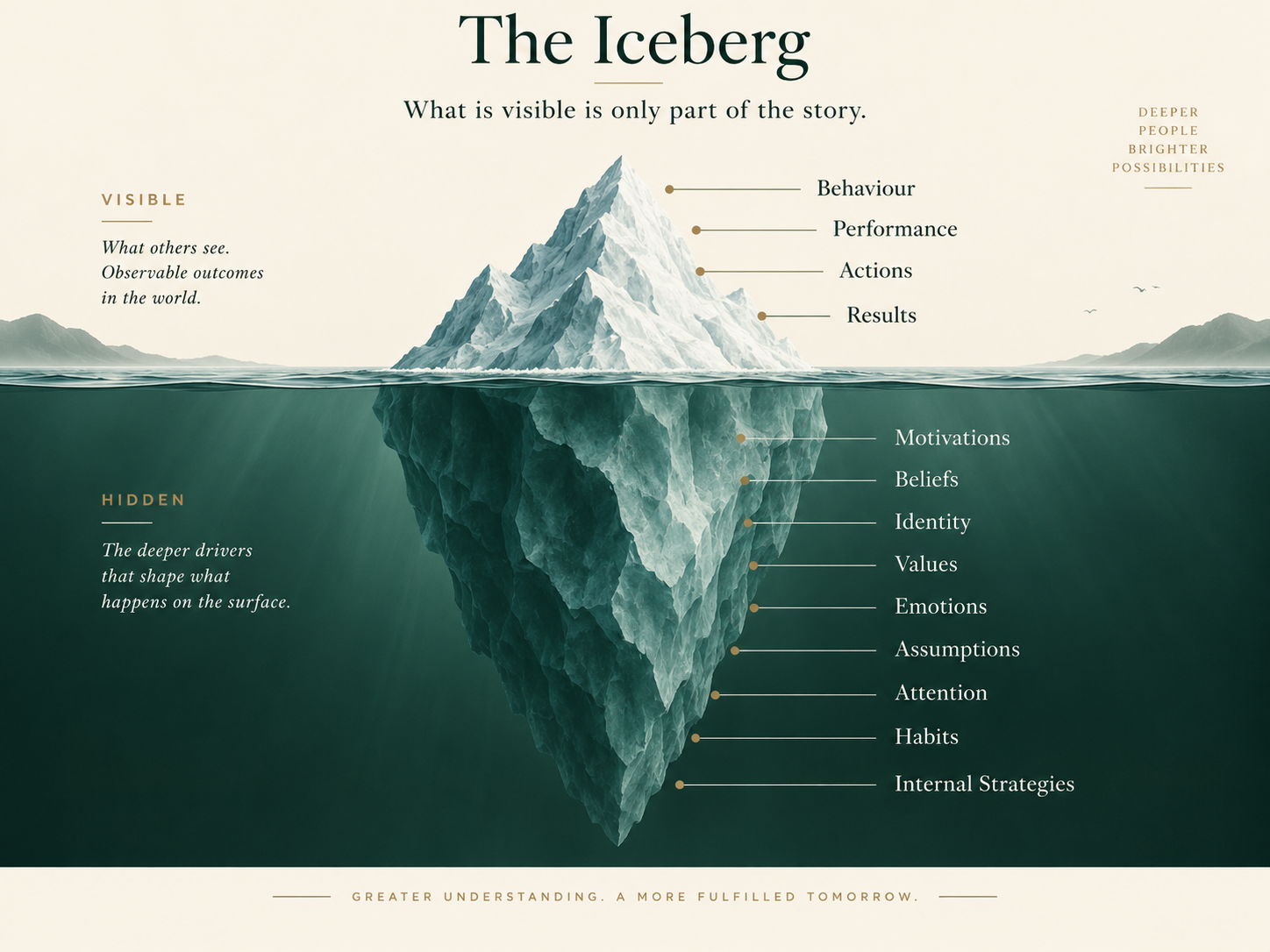
“Performance is visible; capability is not.”
The leader who is decisive with one audience and guarded with another.
The athlete who can execute the skill until the moment acquires meaning.
The team that performs brilliantly in one environment and cautiously in another.
The person who knows what to do—and cannot reliably access it when it matters.
One distinction. Held in one place.
Performance is capability expressed through the conditions of a real moment.
How much of what is already there is actually arriving—here, now, under these conditions?
X — Expression
How much of that capability became usable and observable.
Beneath the observable result
Interference
“What is consuming attention or preventing capability from organising itself in time?”
The diagram organises questions; it does not make hidden causes directly observable.
“Interference does not always remove capability. It can prevent capability from organising itself in time.”
Why diagnosis matters
A senior team appears to need presentation training. Yet the same leaders are decisive elsewhere. Their hesitation appears mainly in one forum where information arrives late, decision criteria change and recommendations can be overturned without warning.
The presenting symptom is cautious communication.
The actual constraint may sit somewhere else.
“Training alone would have treated the visible symptom as the diagnosis.”
The Seven Moves
The equation is the idea. The question is the lens. The Seven Moves are the practice.
“Do not ask which explanation sounds persuasive. Ask which explanation survives a fair test.”
One organising picture. Multiple expressions.
The Power of X is an organising picture of human performance—expressed through a model, a book, an organisational diagnostic, an expanding body of insight and a growing conversation about what allows capability to arrive.
P = C × X. A disciplined way of separating what arrived, what was available and what affected expression.
The long-form exploration of the model, its inheritance, its boundaries and its applications.
The practical diagnostic method: pause, define, prove, compare, locate, test and learn.
Writing and original thinking about capability, interference, systems, identity and transition.
Conversations about capability, interference and what allows human performance to arrive.
A growing challenge to the assumption that one observed performance represents the complete capability of a person, team or organisation.
“A performance event is evidence about the person. It is not a complete inventory of the person.”
The Power of X · Coming soon
Join for release updates, early extracts, preorder access and podcast launch information.